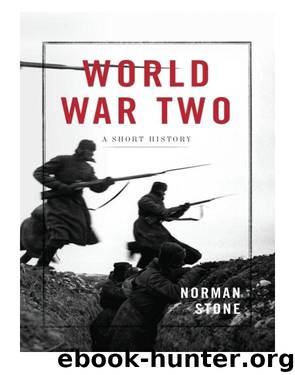
World War Two: A Short History by Norman Stone
Author:Norman Stone [Stone, Norman]
Language: eng
Format: epub
Tags: History, Europe, General, Military, World War II, United States, 20th Century, Modern
ISBN: 9780465033478
Google: fZdAwXYhgg4C
Amazon: 0465013724
Goodreads: 19002966
Publisher: Basic Books
Published: 2012-01-01T00:00:00+00:00
chapter six | FANATICISM AND HATE, MUDDLE AND DELAY
preceding page: US Navy Dauntless dive-bombers during the Battle of Midway, June 1942 (Bettmann/Corbis)
The eventual end of the Third Reich was clear. Two-thirds of the men trapped at Stalingrad had died, and the remaining 90,000 prisoners marched off through the snow to semi-starvation in camps. Some Germans themselves—staff officers of Army Group Centre most obviously—thought of just murdering Hitler (and one or two efforts did get very close to success). But by now the war had created its own momentum, and the mass of Germans were gripped by a surreal paroxysm. Hitler waved aside any mention of peace, and many Germans were executed for defeatism if they doubted Endsieg, ‘final victory’. How were the western Allies to deal with this? Churchill and Roosevelt met in Casablanca in January 1943 at more or less the same time as Paulus surrendered at Stalingrad, and they now had to plan for cooperation with a victorious Red Army. Stalin himself wanted a second front as soon as possible, an amphibious invasion of France, and was contemptuous of Churchill’s prevarications. Eventually the old man, in Moscow in August 1942, had to explode at Stalin, saying why did he think Hitler had not invaded the British Isles after Dunkirk, when there was no army to resist? The fact was that an amphibious operation over the Channel was just very difficult. In British history, after the Battle of Hastings in 1066, there had only been one successful invasion, that of William of Orange in 1688, and even then that worked only because much of England was on his side. There were not many English invasions of western Europe, either, and some had ended in near-farce, such as the episode at Walcheren against Napoleon in 1809.
Even so, Stalin was right: an invasion should have been possible in 1943, and the Americans—especially George C. Marshall, with his granite-like honesty and his grasp of essentials—knew as much. But at Casablanca, they were not prepared. The British still had the main military hand, they were by now experienced, and with facts and figures could present a case that, given also their superiority in rhetoric, won the Americans over. If Tunis had been taken quickly, perhaps there would still have been time in the campaigning season for a cross-Channel attack. However, there were major delays and Tunis was not cleared until mid-May. A great army, with the wherewithal for an invasion, was thus encamped along the North African shore just south of Italy. The British (or most of them) were in favour of an invasion of Sicily, and the Americans (or most of them) were in favour of something else. But it was the British who won the argument. This shaped the rest of the war.
The fact was that most of the British thought that there must never be a repetition of the Western Front battles, whether of 1916 or of 1940. They had been beaten again and again by the German army, and knew that their own strengths were elsewhere— the air and the sea.
Download
This site does not store any files on its server. We only index and link to content provided by other sites. Please contact the content providers to delete copyright contents if any and email us, we'll remove relevant links or contents immediately.
| Africa | Americas |
| Arctic & Antarctica | Asia |
| Australia & Oceania | Europe |
| Middle East | Russia |
| United States | World |
| Ancient Civilizations | Military |
| Historical Study & Educational Resources |
The Radium Girls by Kate Moore(12026)
100 Deadly Skills by Clint Emerson(4924)
Rise and Kill First by Ronen Bergman(4785)
The Templars by Dan Jones(4689)
The Doomsday Machine by Daniel Ellsberg(4489)
The Rape of Nanking by Iris Chang(4211)
Killing England by Bill O'Reilly(4001)
Stalin by Stephen Kotkin(3965)
Hitler in Los Angeles by Steven J. Ross(3946)
12 Strong by Doug Stanton(3548)
Hitler's Monsters by Eric Kurlander(3341)
Blood and Sand by Alex Von Tunzelmann(3203)
The Code Book by Simon Singh(3189)
Darkest Hour by Anthony McCarten(3129)
The Art of War Visualized by Jessica Hagy(3007)
Hitler's Flying Saucers: A Guide to German Flying Discs of the Second World War by Stevens Henry(2754)
Babylon's Ark by Lawrence Anthony(2676)
The Second World Wars by Victor Davis Hanson(2524)
Tobruk by Peter Fitzsimons(2516)
